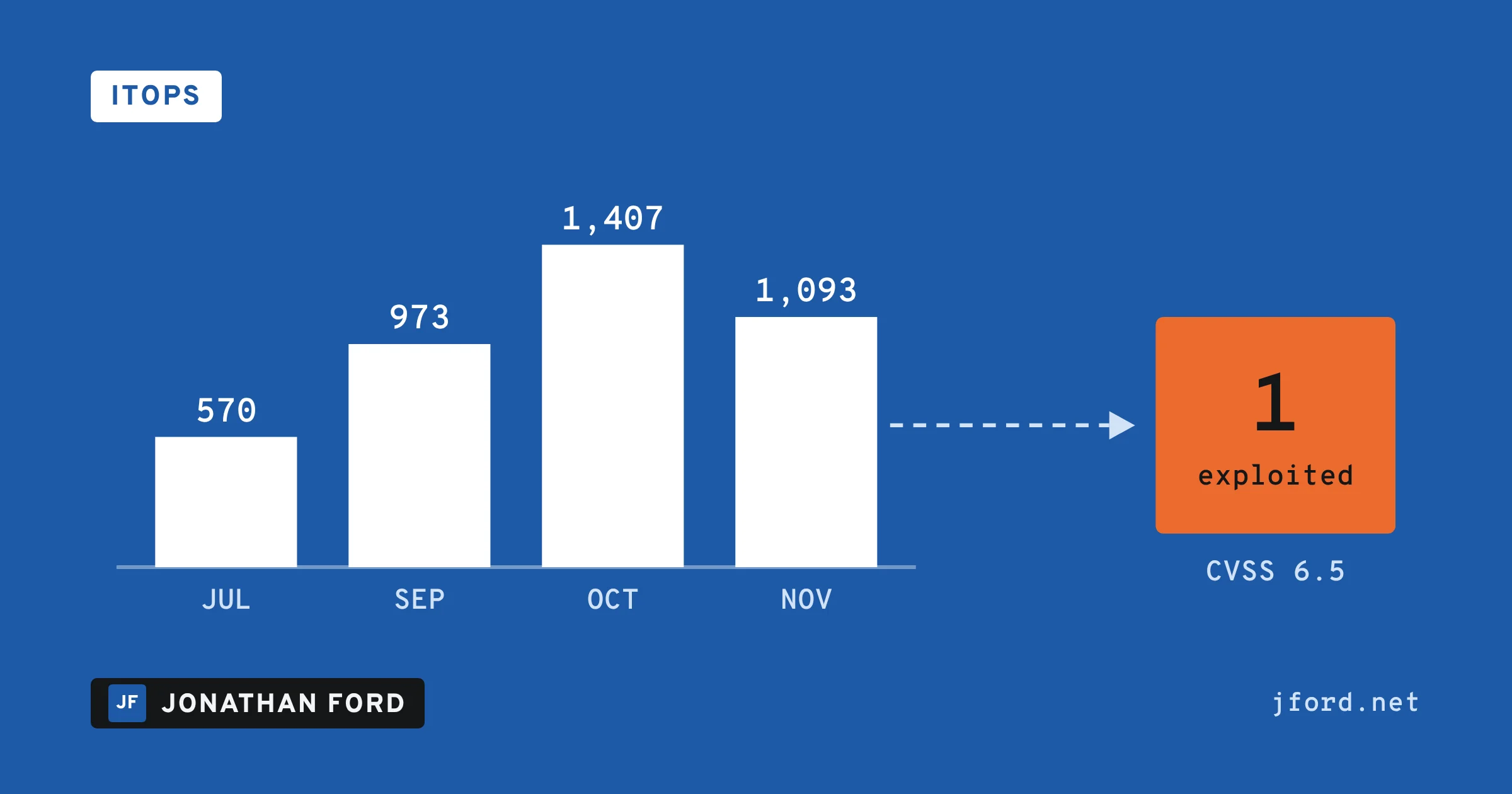
Microsoft's November Patch Tuesday fixed 1,093 vulnerabilities, not counting Edge, by IT-Connect's count. That's the second-biggest release ever, behind October's 1,407. Sixty-three are rated critical. Exactly one was being exploited when it shipped, and it scored a 6.5.
That gap is the whole story for anyone who runs a patch program. If your process still starts with "how many critical CVEs this month" and works down a CVSS-sorted spreadsheet, it broke sometime this summer. You just may not have noticed yet, because the deployment tooling kept up even when the triage didn't.
My take: stop triaging the release and start triaging your estate. Patch everything on a fixed ring schedule without reading it, and spend human attention on two short lists: what's exploited, and what's exposed.
How we got here
Microsoft told us this was coming. In July, Windows chief Pavan Davuluri wrote that "customers will see a higher volume of security updates included in each security release," as Thurrott reported, because AI scanning, including Microsoft's multi-model MDASH harness, is finding old bugs faster. Days later, July's release fixed at least 570 flaws, nearly triple June's. September hit 973. October cleared 1,400.
Fortra's Tyler Reguly told CSO Online he expects the numbers to decline once the backlog of long-hidden bugs clears. I'd like that to be true. I'm not planning around it. Every major vendor now has the same tools, and so does every attacker. Plan for this as the new normal and enjoy it if it fades.
The 6.5 that mattered
The exploited bug is CVE-2026-124194, an Outlook spoofing flaw. A user opens a crafted file, Outlook reaches out to an attacker-controlled location without its usual external-content warning, and the user's NTLMv2 hash goes along for the ride. From there it can be relayed or cracked. Microsoft rates it Moderate. CISA put it in the Known Exploited Vulnerabilities catalog with a November 24 deadline for federal agencies.
Sort November by CVSS and this one lands well below four 9.8s and dozens of other critical RCEs. Sort by "is anyone using this right now" and it's the only thing on the list.
There's a second trap in it. As eSecurity Planet points out, the Windows cumulative update doesn't fix it. The fix is in Office: Microsoft 365 Apps and Office LTSC 2021 and 2024. If your compliance dashboard reports Windows patch level and calls it done, it will show green while every Outlook client in the building stays exposed. Check which Office update channel your fleet is on and how long that channel takes to land a security build. For a lot of shops on Semi-Annual Enterprise, the honest answer is "longer than you'd like."
This is also a reminder that NTLM is still the soft spot. Hash-leak bugs in Outlook and Windows show up every year. Block outbound SMB at the perimeter, put privileged accounts in the Protected Users group so they can't use NTLM at all, and start auditing outgoing NTLM traffic so you know what breaks before you restrict it. Those steps blunt the next one of these before it's announced.
What I'd change in the process
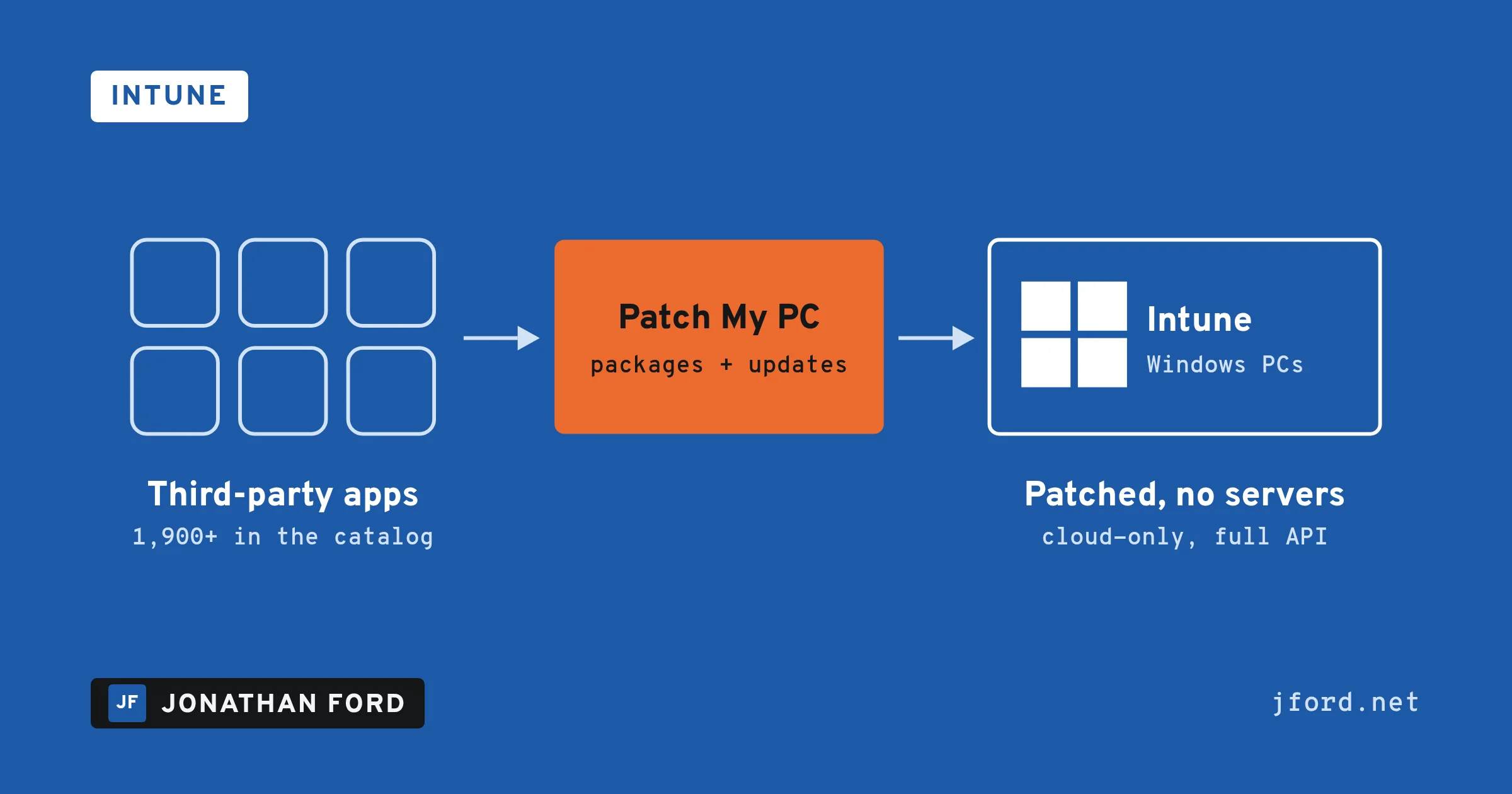
Make the bulk of the release boring. At a thousand fixes a month, no one is reading the notes, so stop pretending. Ring-based deployment through Autopatch, Intune update rings or whatever you run, with a pilot ring that gets the update within a day and broad deployment inside a week or two. The schedule is the control. Nobody approves line items.
Keep a short list that skips the line. Anything in CISA's KEV catalog, and anything a vendor marks as exploited, gets pushed to the affected population on an expedited ring the same week. That list was one item long in November. It's short by nature, which is why a human can own it.
Sort the rest by reach, not score. Action1's Jack Bicer told CSO to patch by reach: domain controllers and Exchange first, then anything facing untrusted networks. I agree. November's LDAP RCE, CVE-2026-119958, is unauthenticated and sits on your domain controllers. That gets attention because of where it lives, not because it says 9.8. A 9.8 in a component you don't run is noise. Your asset inventory, not the CVE list, is the most important input to triage now.
Shrink the window, because attackers already have. Dustin Childs of the Zero Day Initiative warned that AI makes patch-diffing and exploit building near-instant, so the clock starts when the update ships. A 30-day patch SLA for servers was defensible when exploits took weeks to show up. That math has changed. If your broad ring takes a month, that's the number to work on, and it's mostly a testing and change-approval problem, not a tooling one.
Measure the right thing. Report time-to-patch for KEV items and for internet-facing systems, plus ring compliance across the fleet. Drop the monthly slide that counts CVEs fixed. At this volume it only measures Microsoft's AI budget.
The number I watch now is how many days my most exposed systems sit unpatched after an exploited fix ships. Get that down, keep the rings moving, and the other thousand fixes mostly take care of themselves.