Every time somebody brings up the Group of Six splitting off from the Power Four, people act like it's surrender. Like it means admitting schools like Louisiana Tech don't belong in big-time college football anymore.
I'm struggling to understand why that's so abhorrent. Look at where things are and a split doesn't look like giving up. It looks like the only option that makes sense. It just has to be done carefully.
One seat at a bigger table
The College Football Playoff is headed to 24 teams in 2027: four Power Four champions, the highest-ranked Group of Six team and 19 at-large bids. Double the field, and the G6 still has the one guaranteed seat it has now. Could a second G6 team get in as an at-large? Don't count on it. The committee is going to take a three-loss SEC or Big Ten team over a two-loss Sun Belt team every time.
When the G6 does get in, it hasn't gone well. Tulane and James Madison both made last year's field, and both got blown out in the first round.
The money is no better. Under the new playoff revenue split, the Big Ten and SEC take 29% each, the ACC 17% and the Big 12 15%. The six G6 conferences and Notre Dame split the last 10%. A bigger pot doesn't change the G6's share of it.
A farm system with no fees
The playoff is the smaller problem. The bigger one is that every G6 roster is now a feeder system for the Power Four, and the Power Four doesn't pay a dime for it.
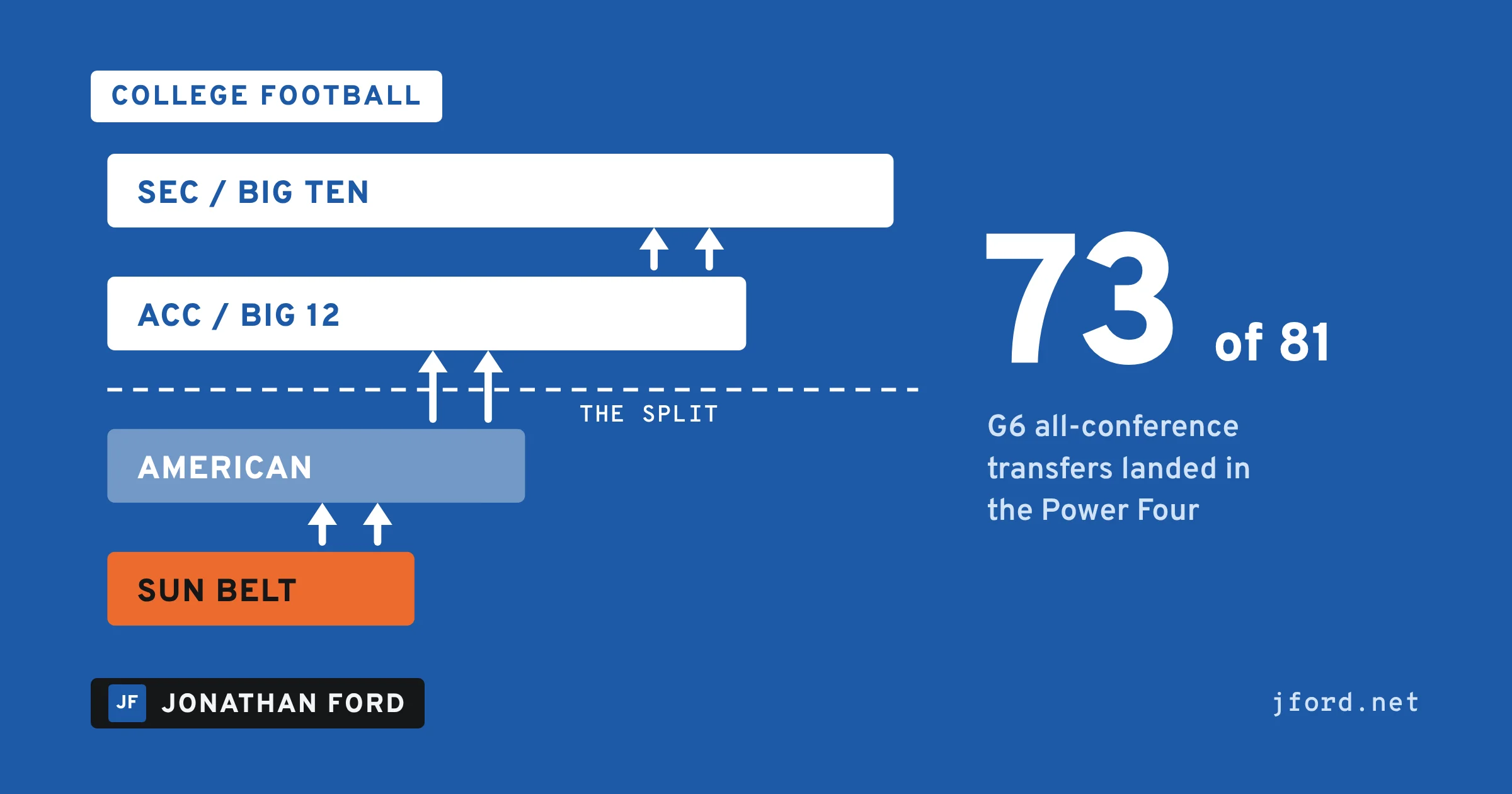
CBS Sports tracked the 2026 portal cycle: 81 of the G6's 114 returning all-conference players transferred, and 73 of them landed at Power Four schools. The G6 kept 29.5% of its all-conference players. The Power Four kept 74.6%. The Sun Belt lost 13 of 18.
That's the cycle Tech lives in. The Bulldogs are 7-2 and unbeaten in their first year of Sun Belt play. The reward for a year like that is January, when the portal opens and the best players on the roster get offers Ruston can't match. Sonny Cumbie's staff finds them, develops them and hands them off. Then they start over.
The money makes it permanent. Schools can pay players up to $21.3 million this year, and most of the Power Four pays all of it. Tech can't come close, and it's losing about $3 million over 10 years as its share of the House settlement that set up that system.
Whole programs get poached too. James Madison announced last month that it's leaving the Sun Belt for the American, and it moved when it did to beat a Sun Belt vote on raising the exit fee. The American will get raided the same way when the ACC or Big 12 comes calling for Memphis, Tulane or USF. Every rung on the ladder raids the one below it, and the haves keep getting more.
The TV money points the same way. Fox is all in on the Big Ten. ESPN is all in on the SEC. The Sun Belt's deal is with ESPN too, and ESPN is cutting costs. Either ESPN keeps paying up for the SEC and squeezes everybody else, or the market cools and the cuts start at the bottom. Neither is good for Tech.
No amount of coaching or hustle closes a gap like that.
Basketball isn't the escape hatch
The usual answer is that basketball is different. You only need a handful of players, and one hot March can put a small school on the map.
That used to be true. But in basketball, "power conference" doesn't mean what it does in football. Most Big East schools have no football to pay for, and they set aside about $5.7 million on average for men's basketball players last season. VCU's athletic director put the cost of staying on top in the A-10 at around $5 million a year. Gonzaga built a national power in the WCC, moved to the Pac-12 this summer, and its athletic director has admitted to a "structural advantage" in putting more of its revenue-sharing money into men's basketball. The Pac-12 is a G6 league in football. In basketball, it has Gonzaga.
Power Four schools still outspend most of them once NIL money is added. Either way, the arms race in basketball is the Big East, Gonzaga and the top of the A-10 against the SEC and Big Ten. The Sun Belt isn't part of it, except as a place to take players from.
The 76-team NCAA tournament coming in 2027 won't help. When Sports Illustrated mapped a 76-team field for last March, seven of the eight added teams came from Power Four leagues.
Make the break, but make it right
The best argument against separation is that the G6 has a guaranteed playoff seat and a cut of the money right now, and a split would let the Power Four stop sharing either one. A separate G6 postseason, the argument goes, would give the power brokers an easy way out of including anybody else.
That's a fair worry. It's also the reason a split can't be left to happen on its own, which is where things are headed now. It has to be negotiated, in writing, before anybody walks out the door, and it has to include a few things:
- The payouts stay. Whatever the G6 gets from the CFP and the NCAA tournament today, the Power Four keeps paying. That goes for guarantee games too. Power Four schools are paying G6 opponents an average of $1.3 million this season and FCS opponents about $525,000. LSU paid Tech $1.6 million to come to Baton Rouge in September. If the Power Four starts treating a separated G6 like the FCS, that check drops by more than half. Separation can't be a pay cut with a new name.
- Development gets paid. If a Power Four school takes a player Tech recruited and developed, Tech gets compensated. Northern Illinois athletic director Sean Frazier called for exactly that last year: "It's time to pay." Soccer figured out transfer fees a long time ago.
- A postseason that means something. A real G6 playoff with its own TV deal and a champion that actually played for it. American commissioner Tim Pernetti has already floated a version of one.
None of that is easy. But the alternative is what we have now: a G6 that technically plays the same sport as Ohio State and Georgia, gets one token seat in their playoff, and spends every January watching its best players leave for them. I'd rather Tech play for something real than keep pretending.